
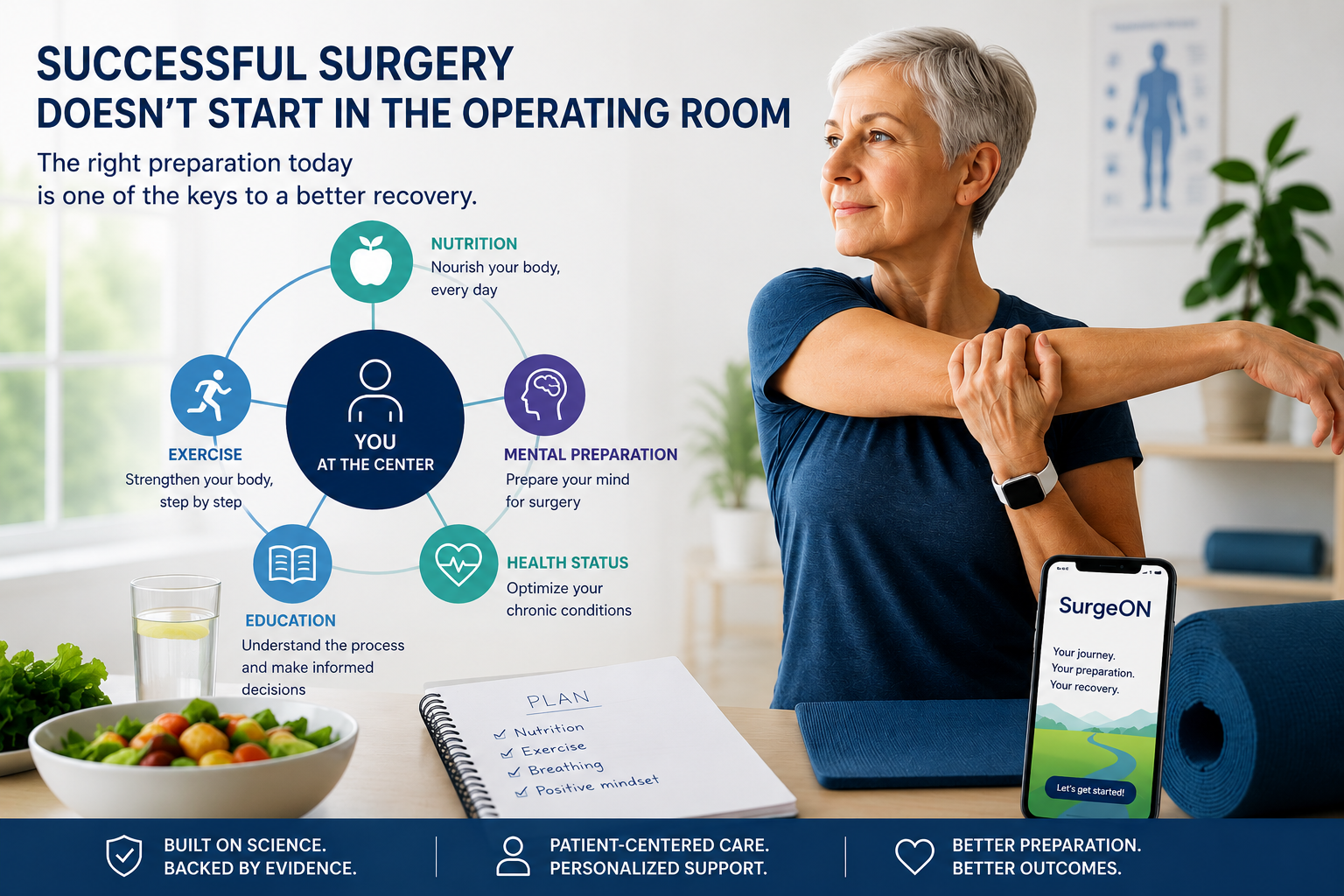
When most people think about surgery, they picture the operating room—the surgeon, the anaesthesiologist, the medical team, and the procedure itself.
Yet modern medicine has shown us that the success of an operation depends on much more than what happens during surgery.
A patient’s physical fitness, nutritional status, mental resilience, lifestyle, and overall health can all have a significant impact on surgical outcomes and recovery.
This is the principle behind prehabilitation.
Prehabilitation is far more than simply exercising before surgery. It is a structured, evidence-based approach that prepares patients physically, nutritionally, and psychologically before an operation, helping them face surgery in the best possible condition.
An increasing number of clinical studies have demonstrated that well-designed prehabilitation programs can contribute to:
- reducing postoperative complications,
- shortening hospital stays,
- accelerating functional recovery,
- improving quality of life,
- and helping patients return to their daily activities sooner.
At the same time, healthcare systems around the world are facing unprecedented challenges.
Populations are ageing. Chronic diseases are becoming more common. Surgical waiting lists continue to grow, while healthcare professionals are working under increasing pressure.
These challenges require more than advances in surgical techniques alone.
They require better patient preparation.
This is where digital health has the opportunity to make a meaningful difference.
Digital solutions are not designed to replace surgeons, nurses, physiotherapists, or dietitians. Instead, they can extend the reach of healthcare teams by providing patients with continuous education, personalized guidance, motivation, and support throughout the entire perioperative journey.
This belief has been at the heart of SurgeON since the very beginning.
Our mission is simple:
To help every patient arrive at surgery in the best possible condition—and recover with confidence afterwards.
Over the coming months, we will be sharing evidence-based articles exploring prehabilitation, perioperative care, ERAS principles, nutrition, exercise, mental preparation, and the future of digital surgical care.
Our goal is not only to explain the science, but also to make it practical and accessible for patients, healthcare professionals, and healthcare organizations alike.
Because we believe the future of surgery is not defined solely by what happens in the operating room.
Successful surgery begins weeks before the first incision.